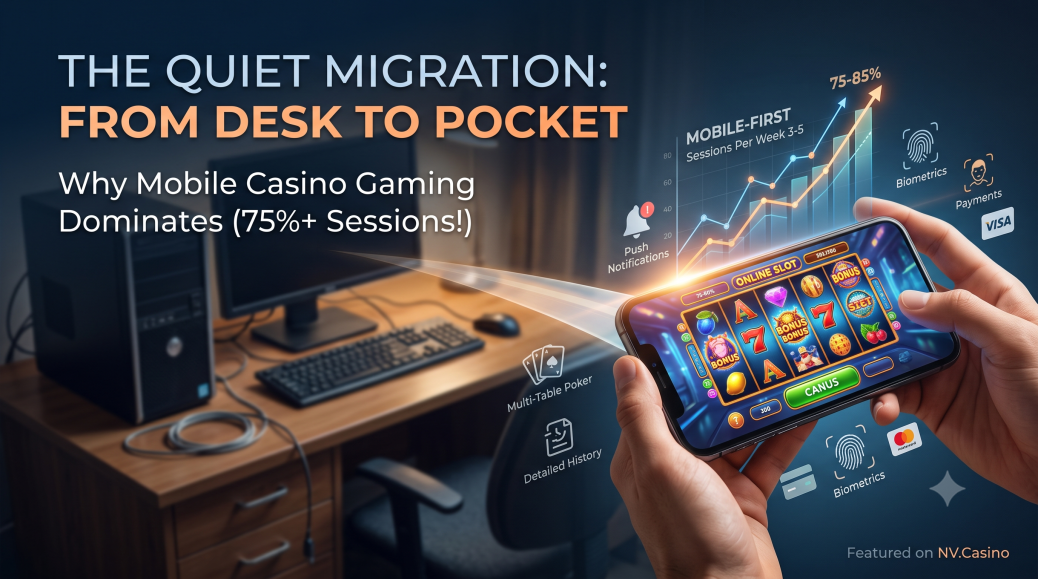
The shift toward mobile in online casino play happened so gradually that most players living through it never noticed when the balance tipped. Five years ago the desktop client was the default and the mobile site was the convenience option. The relationship has reversed across nearly every operator metric, and the reasons are worth understanding for anyone who still defaults to a laptop session out of habit.
How Quickly the Balance Shifted
The mobile-first move in iGaming tracked the broader consumer shift toward smartphones, but at a faster pace. Industry trackers and operator reports now consistently put mobile share of online casino sessions above 75%, with several reports putting the figure closer to 85% in mature European markets. The reasons are practical rather than ideological: the device the average player carries is now powerful enough to run any casino game at the same fidelity as a desktop client, and the friction of opening a laptop after a long workday is real.
The Device Shift in Numbers
The numbers behind the shift make the trend hard to ignore.
| Metric | 2019 Baseline | 2025-2026 Reality |
| Mobile share of casino sessions | ~50% | 75-85% |
| Average session length on mobile | 15-20 minutes | 30-45 minutes |
| Sessions per active player per week | 1-2 | 3-5 |
| Smartphone access to online casinos (mature markets) | ~60% | 80%+ |
| Native app penetration vs browser play | Mostly browser | Roughly split |
The growth has been driven by parallel improvements in three areas. Smartphone hardware became fast enough to run slot animations and live dealer streams without dropping frames, mobile network speeds improved to the point where buffering on live tables became rare, and operators rebuilt their entire game catalogs to work natively on touch interfaces rather than treating mobile as an afterthought. Each improvement reinforced the others, and the desktop session became a niche use case for specific game types rather than the default experience.
What Mobile Actually Does Better
The advantages over a desktop session are not subtle once a player tries both side by side. A short list of what mobile delivers that the desktop client cannot:
- Sessions that fit into 10-minute windows between other activities, rather than requiring a dedicated time block.
- Push notifications for tournaments, promotions, and bonus drops that arrive in real time.
- Biometric login through face or fingerprint recognition, which removes the password friction.
- Portrait-orientation game design that fits slots, instants, and crash games naturally.
- Location-aware features for operators that need to verify regional eligibility.
The lobby of a typical operator catalog reflects these priorities. The catalog at https://www.nv.casino/en is organized for one-handed scrolling, with category rails that match the touch interaction patterns players use across every other app on the same device. The desktop version of the same catalog exists and works fine, but the design choices read as a port of the mobile experience rather than the other way around.
Native Apps Versus Browser Play
The choice between downloading a dedicated app and playing through the browser is the one decision most players still get wrong by accident. The differences between the two paths are real but often invisible until a player tries both. Native apps generally give faster load times, smoother animations on weaker connections, biometric login by default, and offline access to non-gameplay screens like account history and promotion lists. The trade-offs are real too: iOS App Store policies restrict real-money apps in many jurisdictions, which forces some operators to ship as a web-based progressive app rather than a native one, and Android sideloading creates security considerations that browser play avoids.
Operators that have built a native option usually maintain a dedicated download landing page, and the mobile casino nv page covers the Android download path for users who prefer the app experience over the browser version. The browser path remains the universal fallback. Any modern phone browser running on iOS or Android can load a casino lobby and play any HTML5 game in the catalog, which is how most sessions still actually start.
The Trade-Offs Worth Knowing About
Phones win at most things, but not all of them. A few honest concessions are worth carrying into the choice between devices. Multi-tabling at the poker tables remains a desktop-first experience because the screen size simply does not fit four or six simultaneous tables on a handset. Live dealer streams look better on a 27-inch monitor than on a 6-inch screen, even with identical underlying video quality. Detailed account work, like checking transaction histories or comparing bonus terms, is easier when the operator’s text-heavy pages have room to breathe. None of those exceptions reverse the broader pattern. Most players play slots, instants, crash games, and occasional live blackjack hands, and all of those formats work better in a 10-minute handset session than in a planned desktop one. The pocket has become the default screen, and the operator lobbies that recognized this earliest are the ones holding the longest weekly session totals among their active player base.
